The Big Picture
Anton Chekhov’s masterful short story, “The Bet,” pulls us into a high-stakes wager that tests the very limits of human endurance, sanity, and purpose. It gently forces us to ask whether physical freedom is truly meaningful if the mind remains enslaved to greed, vanity, and shallow social illusions. Through the solitary confinement of a young lawyer, we witness a profound transformation from a restless mind chasing millions to an awakened soul that discovers ultimate truth. Ultimately, it is a brilliant, unhurried meditation on the passage of time, the pursuit of wisdom, and the emptiness of worldly wealth.
The Premise and The Argument
Picture a dark, howling autumn night in nineteenth-century Russia. Inside a warm, opulent estate, a gathering of clever men, journalists, and intellectuals are engaged in a heated dinner-party debate. They are discussing the heavy morality of capital punishment versus life imprisonment. The host—a wealthy, self-important banker—passionately argues that execution is far more humane. To him, tearing a man away from life instantly is better than the slow, agonizing drain of life behind bars. Opposing him is a young lawyer, twenty-five years old, full of youthful arrogance and stubbornness, declaring that to live in any capacity is always better than not living at all.
The argument quickly devolves from abstract philosophy into a deeply personal clash of egos. The banker, spoiled beyond reckoning by his millions and reckless in his confidence, strikes the table with his fist. Driven by blind arrogance, he wagers two million rubles that the young man could not endure even five years in solitary confinement. The young man, caught up in the heat of the moment and perhaps a quiet desperation for wealth, not only accepts but foolishly triples the duration—staking fifteen of the best years of his life.
At that moment, the true nature of the wager is laid bare. It is not a noble pursuit of truth; it is a collision of a pampered man’s caprice and a young man’s greed, wrapped in intellectual posturing. The banker cruelly mocks him, reminding him that voluntary imprisonment is a slow poison, as the knowledge that one can walk out at any second will constantly haunt him. What begins as a careless dinner party boast instantly transforms into a heavy, life-altering sentence for both men.
- Quick Byte: Intellectual debates driven by ego and unchecked pride often lead us into the deepest self-made traps of our lives.
Terms of the Confinement
The heavy reality of their wild, senseless wager soon sets in. It is decided that the young lawyer will spend the next fifteen years locked inside a small garden lodge on the banker’s sprawling estate. The rules of his sadhana—his long, isolated undertaking—are absolute and terrifyingly strict: zero human contact. He is forbidden from crossing the threshold, seeing another human face, hearing a human voice, or receiving letters and newspapers from the outside world. He is completely sealed off from society, beginning exactly at twelve o’clock on November 14, 1870.
His only lifeline to the breathing world is a small, purposely built window. Through this tiny opening, the lawyer is permitted to pass written notes to request anything he desires to make the slow march of time bearable—books, musical instruments, fine wine, or food. The banker, acting as a strange blend of jailer and host, is contractually bound to provide whatever is asked, in any quantity. The lodge becomes an absolute vacuum, where the lawyer is left alone with nothing but his own restless mind.
The financial catch, however, is brutal and absolute. The young man must endure every single day until exactly November 14, 1885. If he breaks the conditions and leaves his prison even two minutes before the deadline strikes, he forfeits the two million rubles entirely. It is a profound psychological cage where the door is effectively unlocked, demanding supreme discipline to stay inside while life outside continues without him.
- Quick Byte: True imprisonment is not just the walls around us, but the constant, agonizing temptation to abandon our commitments when the door is left unlocked.
The 15 Years of Evolution
As the door seals shut, a grueling psychological metamorphosis begins, marked by distinct eras of survival and surrender. During the first two years, the crushing weight of loneliness nearly breaks the young lawyer. Day and night, the heavy, mournful chords of his piano echo from the lodge. He vehemently refuses wine and tobacco—realizing that wine awakens desires, the absolute worst enemy of a captive, and tobacco only soils the stagnant air of his small cell. He seeks an escape from his own mind, consuming hundreds of light, sensational novels with complicated love plots and fantastic twists, desperate for any distraction from the terrifying silence of his isolation.
By the fifth year, the piano abruptly goes silent, and a dark, suffocating depression sets in. The prisoner begins demanding wine. Observers note him lying on his bed for hours, yawning, eating, and muttering angrily to himself in the quiet dark. In a frenzy, he spends his nights writing furiously, only to tear every page to shreds by morning. He weeps often, mourning the loss of his youth and grappling with the deep, hollow emptiness of his confinement. But out of this agonizing breakdown emerges a voracious intellectual rebirth. He throws himself entirely into mastering languages, history, and philosophy, consuming over six hundred dense volumes in four years. In a rare moment of triumph, he writes a letter in six different languages, begging the banker to fire a shot in the garden if the translations are flawless. Two shots ring out. He has found unearthly happiness in human genius.
Yet, this intellectual gluttony eventually gives way to an eerie, monk-like devotion. For an entire year, a man who conquered hundreds of complex volumes sits completely motionless, studying nothing but one thin, easily understood book: the New Testament. From the gospels, he moves into the deep waters of theology. In his final years, his reading becomes wildly erratic and desperate—a drowning man frantically clutching at floating wreckage. He demands chemistry manuals, Shakespeare, medicine, and philosophy all at once, attempting to absorb the absolute totality of human knowledge before his time runs out.
- Quick Byte: Solitude forces us to face our deepest demons; only when we stop running from the silence do we truly begin to transform and seek enduring wisdom.
The Climax
As the eve of the deadline approaches, a grim reversal of fortunes sets the stage for a tragic climax. The arrogant, untouchable millionaire who once threw around fortunes without a second thought is now a desperate, trembling old man. Fifteen years of wild speculation, reckless gambling on the Stock Exchange, and an addiction to financial adrenaline have slowly bled his empire dry. Paying the two million rubles now will bankrupt him utterly, reducing him to a beggar in the eyes of society. Consumed by jealousy and panic, he curses the prisoner, wondering why the man didn’t simply die in that room. In his twisted, desperate mind, the only salvation from public ruin and disgrace is murder.
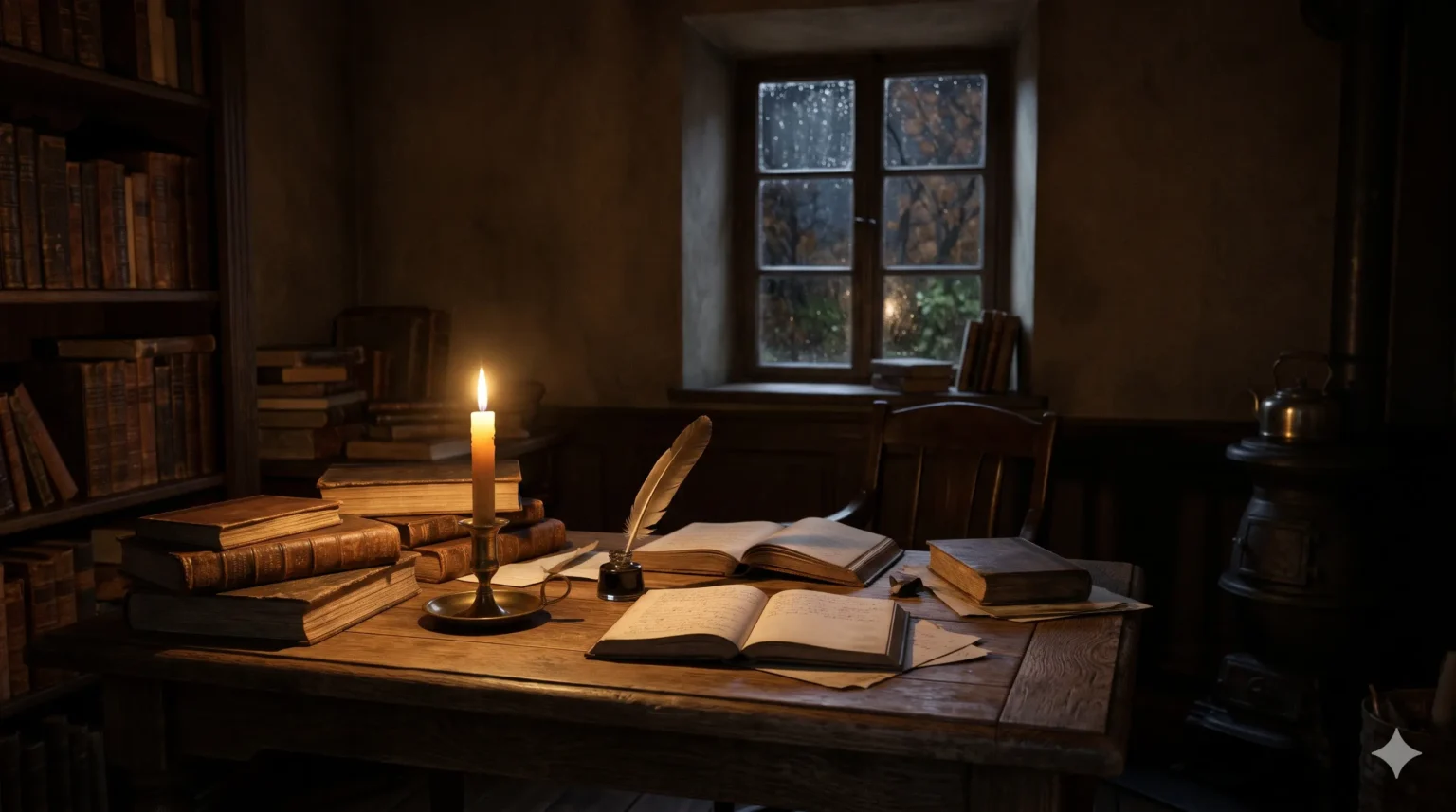
In the dead of a freezing, rain-swept autumn night, the banker creeps through his howling garden, intending to suffocate the sleeping prisoner and frame the watchman for the crime. He breaks the fifteen-year-old seals, bracing himself for a cry of shock, but the room is utterly silent. He finds the lawyer asleep at his table, surrounded by piles of open books. The man before him is a terrifying sight—a literal skeleton with skin drawn tight over his bones, a shaggy beard, and hair streaked with silver. He is only forty, yet he looks ancient, broken by the physical toll of a life lived entirely inside his own mind.
Before striking, the banker notices a sheet of paper covered in fine handwriting beneath the prisoner’s bowed head. He picks it up to read what he assumes are the ravings of a man obsessed with his impending millions. Instead, he finds a profound, devastating manifesto. The lawyer declares that through his fifteen years of obsessive reading, he has lived a thousand lives—he has loved ethereal women, climbed the peaks of Mont Blanc, conquered kingdoms, and gathered all the wisdom humanity has ever produced. But in acquiring this infinite knowledge, he has realized that worldly blessings, health, and freedom are all fleeting, deceptive mirages. To prove his absolute contempt for the material world, the lawyer declares his intention to climb out of his window five hours before the deadline, deliberately forfeiting the two million rubbles he once dreamed of as paradise.
- Quick Byte: The desperate pursuit of material preservation will drive a man to commit his darkest acts, completely blinding him to his own moral bankruptcy.
- Deep wisdom reveals that the worldly riches and physical comforts we endlessly pursue are just empty, fading illusions. True enlightenment exposes the hollowness of our desires, proving that the wealth and status we chase are merely temporary mirages.
The Resolution
When the terrified watchmen burst in the next morning, pale-faced and out of breath, they deliver the news that changes everything. They saw the prisoner deliberately climb out of his small window, walk to the heavy iron gates, and disappear into the mist. He had carried out his promise to the letter, intentionally forfeiting the fortune just five hours before the absolute deadline.
The banker, accompanied by his trembling servants, rushes to the garden lodge to confirm the impossible. He stands in the empty, silent room that had caged a man for fifteen years. There is no triumph, no relief—only a crushing, unbearable wave of shame. He takes the prisoner’s manifesto from the table, not to frame him, but out of a desperate need to hide the evidence of his own moral defeat. When he returns home, he locks the paper securely in his fireproof safe. He is finally safe from financial ruin, but he is utterly destroyed from within.
At no other time in his life—not even when reckless gambling wiped out his millions on the Stock Exchange—had he felt such profound, sickening contempt for himself. He falls onto his bed, weeping for hours, unable to sleep. The banker is left trapped in the very prison of wealth and social status that the lawyer has just escaped. The young man walked away with nothing but the clothes on his back, yet he achieved absolute liberation. The old man kept his millions, but lost his soul, condemned to live the rest of his days haunted by the ghost of a man who proved that true freedom has no price tag.
- Quick Byte: Holding onto our material attachments often makes us the ultimate prisoners of our own lives.
Wisdom to Carry Forward
The quiet brilliance of Chekhov’s bet lies not in the millions won or lost, but in the slow, agonizing peeling away of human vanity. We spend our lives racing to accumulate wealth, status, and comfort, completely convinced that these things will bring us freedom. Yet, like the banker, we often find ourselves pacing our luxurious rooms, terrified of losing what we possess, and willing to sacrifice our core humanity just to maintain an illusion of power.
The young lawyer’s long sadhana teaches us a painful but necessary truth: real wealth is built in the quiet, unseen spaces of our minds. When we stop running from the silence and strip away the noise of society, we are forced to confront who we actually are. True freedom isn’t the ability to walk wherever we please; it is the quiet resilience of a mind that no longer desperately needs the world’s approval to feel complete.