
The Big Picture
True success during the turbulent teenage years is never a product of raw talent, superficial popularity, or luck; it is the quiet, heavy fruit of deep personal character. To navigate the storms of adolescence, young people must do the unglamorous work of mastering themselves from the inside out, shifting from reactive passengers to proactive drivers of their own lives. By establishing a clear vision, prioritizing effectively, building empathetic relationships, and continuously renewing their energy, teens can construct an invisible, unshakeable scaffolding that turns external friction into profound personal growth.
Get in the Habit
Have you ever looked across a crowded classroom or a bustling school cafeteria and wondered why some of your peers seem to float through their days with an effortless smile, while you feel as though you are carrying the weight of the whole world on your young shoulders? Do you ever find yourself sitting quietly in your room, trying to make sense of why certain problems feel entirely insurmountable, leaving you trapped in a cycle of pure frustration?
The truth, which is both deeply confronting and wonderfully liberating, is that the root of our heaviest struggles often lies right within our own minds. The friction we feel with the outside world is almost always a reflection of our internal perception. We look at a situation through a glass clouded by our own insecurities, our fears of rejection, and our restless anxieties. But here is the profound beauty of human nature: if you have the power to construct that perception, you also possess the quiet, unshakeable power to change it. Changing how you see the world is the first necessary step of sadhana—the dedicated practice of making your own mind and body a sanctuary of peace.
To be a teenager is to live in a beautifully complicated, overwhelming space. You are thrust into a turbulent ocean of emotional highs and crushing lows, academic pressures, shifting friendships, and the sharp, breathtaking pain of early heartbreak. Sean Covey recognized a fundamental truth: the teens who survive this ocean do not operate on luck. They are propelled by specific, deeply ingrained habits. Habits are the silent architecture of our lives. They operate quietly in the background, dictating our choices before we even consciously think about them.
To understand the sheer emotional stakes of these years, Sean shares a remarkably vulnerable memory from his own school days. Like many young boys, he experienced the terrifying, exhilarating rush of a first crush. Her name was Nicole. Sean, crippled by the natural shyness and self-doubt that plagues so many of us at that age, could not summon the courage to look Nicole in the eye and speak his heart. Driven by a mix of hope and fear, he outsourced his vulnerability to his friend, Clar, asking him to act as the messenger of his affection.
Clar approached Nicole, delivered the message, and returned to Sean. But he did not return with good news. Clar coldly informed Sean that Nicole had rejected him, and the reason she gave was that Sean was “fat.” To make the wound infinitely worse, Clar laughed right in his face as he delivered the news.
Take a moment to truly understand the psychological weight of that scene. For a young, hopeful boy, that single, cruel word, combined with the mockery of a trusted friend, is completely devastating. It is the kind of innocent-seeming social interaction that can fracture a young person’s quiet self-worth. Sean was utterly heartbroken. A profound, burning shame washed over him, making him want to disappear entirely, to hide away from the cruel gaze of the world forever.
Many young minds, lacking the right emotional tools, internalize these rejections, allowing the pain to mutate into a lifelong belief that they are unworthy. But changing how we process these hurts requires changing our habits, which is entirely possible through neuroplasticity. If you cross your arms right now, it feels natural. If you force yourself to fold them the opposite way, it feels deeply awkward and uncomfortable. But if you hold that new posture every day for a month, the awkwardness dissolves. The same goes for your mind. You can unlearn the habits that break you, and painstakingly build the habits that save you.
- Quick Byte: You cannot pause the turbulence of your teenage years, but by deliberately dismantling bad habits and practicing new ones, you become the active architect of your own peace.
Habit 1: Be Proactive
When we observe human behavior, particularly in how people respond to sudden adversity, we generally see a division into two distinct camps: those who are reactive, and those who are proactive.
Reactive people are mere passengers in the vehicle of their own lives. When they encounter a pothole or a storm, their immediate instinct is to look outward to assign blame. They blame their parents, their teachers, their circumstances, or the universe itself for their hardships. Proactive people, conversely, are the drivers. They do not deny that storms exist or that potholes cause damage, but they take absolute, unblinking responsibility for how they navigate the vehicle. They understand that while they cannot control the weather, they control the steering wheel.
Let us ground this philosophy in a deeply relatable, painful reality of teenage life. Imagine you have a close, cherished friend. You spend your afternoons together, sharing secrets, and this friend always speaks to you with the utmost sweetness. But one day, by sheer accident, you overhear a conversation. You hear this very same friend speaking terribly about you behind your back, casually dismantling your character to others.
The physical reaction to such a betrayal is immediate: a tightening in the chest, a hot flush of humiliation in the cheeks, and a deep, agonizing ache in the heart. In that critical moment, the path splits in two. You must choose: will you be reactive, or will you be proactive?
If you surrender to the reactive impulse, you hand over your personal power. You might instantly cut the friend off, lashing out with angry words to make them hurt as much as you do. You might retreat into your room, allowing a dark cloud of depression and self-doubt to swallow you whole. Or, driven by a wounded ego, you might launch a counter-campaign, spreading your own malicious rumors to exact revenge. In every one of these scenarios, notice what has happened: you have handed your emotional remote control over to someone who betrayed you. They pressed a button by gossiping, and you automatically reacted by losing your peace. They are dictating your karma.
Now, imagine taking the unhurried, proactive path. You feel the pain—proactivity is not about suppressing emotion—but you insert a pause between the event and your response. You gather your dignity, approach your friend, and calmly articulate exactly what you heard and how deeply it wounded you. You establish a firm, clear boundary that such disrespect has no place in your life. But then, rather than clinging to the heavy baggage of resentment, you choose the profound strength of forgiveness. You decide to ignore the petty drama and offer them the grace of a second chance. Through this mature navigation, the two of you might rebuild the trust, eventually becoming closer friends than ever before. Proactive individuals never let the poor behaviour of others dictate their own internal weather.
- Quick Byte: Between whatever happens to you and your reaction to it, there is a quiet pause; in that pause lies your absolute freedom to choose your response.
Habit 2: Begin with the End in Mind
It is a common tragedy of modern life that we are entirely consumed by the busyness of simply doing things, without ever pausing to ask why we are doing them. We exhaust ourselves sprinting on treadmills, chasing arbitrary goals like grades or social approval without ever stepping back to analyze if these pursuits hold any true value for our deeper selves.
The second habit is a powerful corrective to this aimless wandering: Begin with the End in Mind. It is the practice of drawing a clear, mental blueprint of the human being you aspire to become. If you do not possess the courage to actively author your own life story, the world will gladly step in and write your story for you, usually in a way that serves its interests, not yours.
Consider how this habit of forward-looking vision acted as a lifeline for a young man named Jim. When Jim was only in the ninth grade, he found himself struggling with periods of deep depression and a paralyzing sense of feeling lost. Instead of surrendering to the darkness, Jim developed a profound coping mechanism. Whenever the heavy feelings descended upon him, he would retreat to a quiet, silent space. There, closing his eyes, he would begin to vividly visualize his future as a grown man.
He didn’t just daydream; he built a mental architecture. He visualized the specific education he would pursue, the exact kind of home he would live in, the warmth of his future family, and the faces of the children he would one day raise. By painstakingly planning the grand arc of his life in his mind, Jim cast an anchor deep into the future. He firmly rooted his identity. Because he had such a crystal-clear picture of his ultimate destination, the trivial, day-to-day distractions and pressures of high school lost their power over him. No one could manipulate him into making a choice that conflicted with the beautiful life he was already building in his mind.
Choosing your path wisely is a matter of profound consequence. Sean Covey illustrates this with a deeply sobering story about a good friend of his named Jack. Jack was an ordinary teen who took a trip to Europe and returned fundamentally changed, having brought back a dangerous party drug. Jack quickly gathered a new, reckless circle of friends, and soon, Sean found himself invited into this inner circle to experiment with the drug.
Sean stood at the crossroad. He knew, with absolute certainty, that Jack was walking down a dark and destructive path. Yet, the human friction of the moment was immense—Sean did not have many other close friends at the time, and the deeply ingrained teenage terror of becoming a social outcast, a loner walking the school halls by himself, tugged at his resolve. It would have been so easy to compromise his future for the sake of temporary belonging.
But Sean had a sense of his own end goals. He made the lonely, courageous decision to walk away from Jack’s company entirely, enduring the temporary discomfort to eventually build a healthier circle of friends. The consequences of that choice became tragically clear months later. Jack spiraled into full-blown addiction and, in a devastating end to his young life, drowned in a swimming pool while under the influence. Sean was left to mourn the heartbreaking loss of his friend, carrying a quiet, profound gratitude that he had the strength to look down the path, see where it led, and step away before it was too late.
- Quick Byte: If you do not plant an anchor in a clear vision of your own future, you will easily be swept away by the dangerous, trivial currents of peer pressure.
Habit 3: Put First Things First
If you observe the modern teenager, you will often see a creature entirely overwhelmed by the ticking clock. They are drowning in a sea of planned activities, schoolwork, sports, and social obligations. In such a chaotic environment, survival requires the discipline to Put First Things First. This is the mature art of prioritization—the immense psychological strength to say a joyful “yes” to the things that matter, and the unyielding courage to say “no” to the pressure of trivialities.
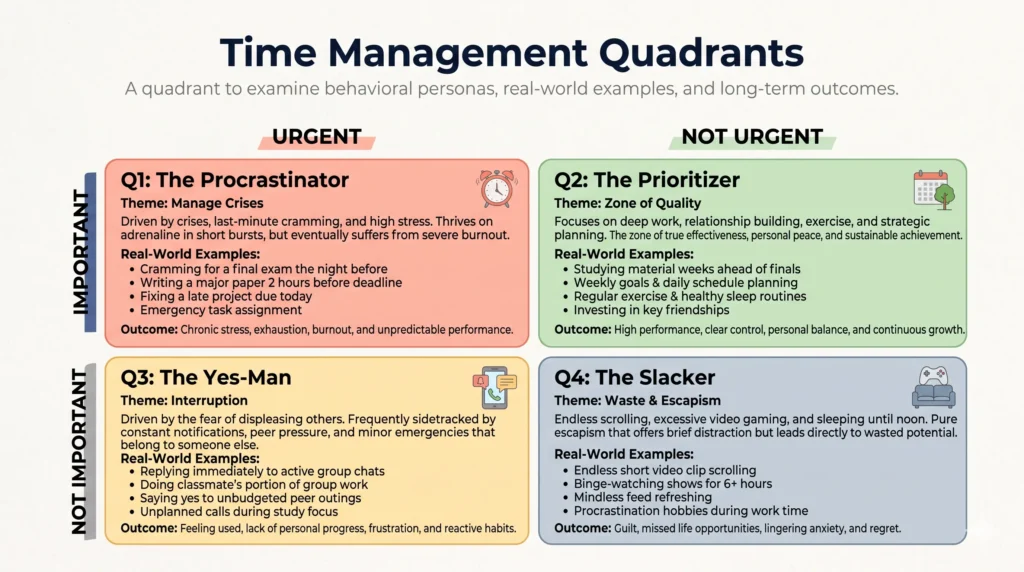
To demystify this, Sean Covey utilizes a brilliant psychological framework known as the Time Quadrant model. This model categorizes every action in our lives based on two specific ingredients: how important it is, and how urgent it is.
The first quadrant belongs to the Procrastinator. They live entirely in the realm of the urgent and the important. This is the student who ignores a major project for three weeks, only to find themselves sitting at their desk at 3:00 AM, fueled by anxiety, desperately trying to finish it before the sun comes up.
The third quadrant is the tragic domain of the Yes-man. They are trapped in a cycle of doing things that are urgent, but entirely unimportant to their own life goals. The Yes-man is driven by a deep fear of rejection. If the Yes-man knows they must study for a vital exam, but friends demand they go cruising, the Yes-man will abandon their own future just to avoid the momentary friction of saying no.
The fourth quadrant is the wasteland of the Slacker. Here, activities are neither urgent nor important. This is the realm of pure, hollow escapism—sleeping until noon, scrolling the internet, mistaking lethargy for true relaxation.
The sanctuary of the highly effective teen is the second quadrant: the Prioritizer. The Prioritizer focuses their energy on things that are deeply important, but not screamingly urgent, like building deep relationships, exercising, and preparing in advance.
- Quick Byte: True freedom is found not in reacting to the loudest, most urgent demands, but in quietly defending your time for the things that are genuinely important.
Habit 4: Think Win-Win
Whenever two human beings interact, their underlying beliefs about success dictate the outcome. Most people operate on a Win-Lose dynamic (climbing over others) or a Lose-Win dynamic (playing the martyr). But any relationship built on the defeat of one party is a house built on sand. The resentment will eventually shatter the relationship entirely.
If you desire bonds that possess a bright, enduring future, you must cultivate the habit of thinking Win-Win. This requires a delicate balance of character: caring about the other person’s feelings while standing up for your own. It is about adopting an Abundance Mentality—realizing the universe is not a pie with limited slices.
Consider the story of Marie. One evening, the peace of the house was shattered by a bitter argument between Marie and her mother over the use of the family car. Her mother, carrying the logistical burdens of the household, insisted she needed the car to buy groceries for the week. Marie, caught up in the immediate social gravity of teenage life, demanded the car so she could go watch a local game with her friends.
Her mother offered a perfectly reasonable compromise: Marie could simply call her friends and ask them to pick her up. But Marie’s ego flared. She stubbornly resisted, arguing that she felt a deep sense of social embarrassment always having to rely on her friends for a ride. Her mother stood her ground, stating the obvious truth that feeding the family was a higher priority than attending a game. Marie simply refused to listen. She wore her mother down with relentless complaining until, finally, her mother surrendered in pure exhaustion.
Marie drove off to her game. She won, and her mother lost. But let us unhurriedly examine the aftermath. Marie’s victory is hollow. She has damaged the goodwill of the person who supports her. The next time a conflict arises, her mother, remembering the resentment of this defeat, will subconsciously keep score and be far less likely to yield. By forcing a Win-Lose outcome, Marie poisoned the well of her own future interactions.
Now, contrast this with a beautiful story of transformation on a high school basketball court. Dawn and Pam were not just teammates on the girls’ basketball team; they were classmates and friends. Dawn possessed a natural, fluid talent for the game. As the season progressed, she began sinking four or five brilliant shots every match, and the school began to buzz with admiration for her skills.
Pam, watching her friend bathe in the applause, fell victim to the most ancient of human insecurities: jealousy. Consumed by a scarcity mindset, Pam made a quiet, bitter decision. During the games, whenever she had the ball, she deliberately refused to pass it to Dawn, even when Dawn was standing wide open in the perfect position to score. Pam would rather the team struggle than watch Dawn receive more glory.
Dawn, naturally, felt a rising tide of irritation and hurt at Pam’s petty sabotage. Frustrated, she went home and poured her heart out to her father. Her father, possessing a profound understanding of human nature, did not advise her to retaliate. Instead, he gave her a piece of deeply counter-intuitive wisdom: Every single time you get the ball, I want you to pass it to Pam.
Dawn initially recoiled at the idea. Why should she reward Pam’s selfishness? But in the next game, she swallowed her pride and executed her father’s instruction. Even when Dawn had a clear lane to make a shot herself, she immediately passed the ball to Pam.
When Pam caught the ball, the surprise on her face was palpable. Dawn was responding to hostility with radical, disarming generosity. Dawn didn’t just do it once; she relentlessly continued to pass the ball to her jealous friend. Over time, the ice around Pam’s heart began to melt. Faced with such unwavering goodwill, Pam’s insecurity dissolved. Soon, Pam began returning the favor, passing the ball back to Dawn. The friction vanished, their friendship was beautifully restored, and operating with a Win-Win synergy, they won countless games, becoming a legendary duo in their small town.
- Quick Byte: You do not need to extinguish someone else’s candle to make your own burn brighter; genuine success is always mutual.
Habit 5: Seek First to Understand, Then to Be Understood
There is a deeply ingrained flaw in human communication: our overwhelming eagerness to speak. We love to dispense free advice, to fix things, to demonstrate our own wisdom. But offering a solution before you have taken the quiet time to truly comprehend the other person’s pain is akin to medical malpractice.
Imagine walking into a store for running shoes, and before you can speak, the clerk shoves garish, uncomfortable formal shoes into your hands, screaming, “These are the best choice for you!” You would drop them and leave. You cannot trust someone who refuses to learn what you actually need.
Sean Covey experienced this exact frustration in a medical setting. After suffering an injury during a strenuous game, his biceps were radiating a burning, agonizing pain. Seeking relief, he visited a doctor and began to carefully describe the specific nature of the throbbing sensation. But the doctor, perhaps rushed or overly confident, waved away Sean’s explanation. He stated abruptly that he already perfectly understood what Sean was experiencing. Without further inquiry, the doctor prescribed a regimen of physical exercises.
Trusting the authority figure, Sean dutifully performed the exercises, only to find that they exacerbated the injury, causing his muscles to scream in even greater agony. Because the doctor had failed the fundamental test of listening, he prescribed the wrong cure. Sean, having lost all faith in the practitioner, never set foot in that clinic again.
To understand the profound, life-altering power of true listening, we must look at the story of Candace. Candace was a high school student battling the terrifying demons of anorexia nervosa—a severe eating disorder rooted deeply in psychological distress regarding body image and control, resulting in a devastating refusal to consume food.
As her frame grew alarmingly fragile, the panic in her ecosystem escalated. Everyone in her high school environment constantly threw advice at her, telling her to simply “eat more.” Her parents, terrified of losing their child to starvation, subjected her to intense pressure. They dragged her from one medical specialist to another, desperate for a doctor who could force a cure upon her. But none of the pressure, the logic, or the medical interventions pierced the armor of her illness. The more they pushed, the more Candace withdrew into the fortress of her disorder, unable to consume a single morsel without immense psychological torture.
When Candace transitioned to college, she moved into a dormitory with three other girls. These young women recognized her severe frailty, but they possessed a quiet, intuitive wisdom. They consciously chose not to treat Candace as a fragile patient, a broken project that required fixing, or a problem to be solved. They simply treated her as a human being.
They did not monitor her plate. They did not barrage her with well-meaning but suffocating advice about nutrition. Instead, they focused on understanding her spirit. They laughed with her, shared their own vulnerabilities, and created a warm, entirely judgment-free space. By simply allowing Candace to exist without the constant, oppressive demand that she change, they built a fortress of absolute trust.
Slowly, within that safe harbor of genuine acceptance, Candace’s internal walls began to lower. Because her roommates had taken the time to truly understand and value her personhood, Candace began to trust their way of living. Without any dramatic interventions, she quietly began to mirror their healthy behaviors, slowly adopting their dietary rhythms until she was peacefully eating three meals a day. You cannot forcefully jam your advice down someone’s throat. You must first do the sacred work of understanding the soul in front of you.
- Quick Byte: People will fiercely reject your most brilliant advice until you have granted them the profound dignity of making them feel entirely heard and understood.
Habit 6: Synergize
It is a common human insecurity to feel threatened by people who are vastly different from us. We naturally gravitate toward those who think, speak, and act just as we do. But when we surround ourselves only with echoes of our own voice, our growth stagnates. Synergy is the profound realization that two minds, working in genuine harmony, can create an outcome far greater than the sum of their individual efforts.
If you want to understand how naturally this principle operates, look away from human society and observe nature. Consider the magnificent rhinoceros and the small birds that rest on its thick back. The birds find an easy source of food by eating bugs off the rhino’s skin, and the rhino is relieved of irritating pests. Both thrive because they allow their differences to serve one another.

But perhaps the most breathtaking example is the flight of geese in their iconic V formation. By flying in this precise structure, the flock achieves an astonishing seventy-one percent greater flying efficiency than if each bird were to fly alone. As the lead bird flaps its wings, it creates an uplift for the bird immediately behind it. The geese in the rear audibly honk to encourage the geese up front to maintain their speed. And when the lead goose inevitably grows tired, it does not fiercely cling to its leadership position out of ego. It gracefully rotates to the back to rest, while another steps up to take the hardest job. If a goose becomes sick and falls, two others will immediately leave the flock to follow it down, offering protection until it can fly again or passes away. Their survival depends entirely on their unity.
We can replicate this beautiful dynamic in our own lives. When Sean Covey was in high school, he formed a deep friendship with a boy named Unga. On paper, they had absolutely no business being friends. Unga was a large, intimidating boy with a reputation as a tough street fighter. Sean and Unga came from completely different worlds in their speech, dress, and daily habits.
If they had operated on superficial judgments, they would have kept their distance. But they found a single, powerful bridge of common ground: the game of football. Instead of letting their vast differences create friction, they brought their unique strengths to the field. They synergized. They understood that you do not need to be a mirror image of someone to build something meaningful with them.
- Quick Byte: True collaboration is not about tolerating differences; it is about actively celebrating them to cover your own blind spots.
Habit 7: Sharpen Your Saw
We live in a culture that relentlessly glorifies busyness, teaching us that exhaustion is a badge of honor. Teenagers run themselves into the ground, operating on empty reserves until their bodies or minds inevitably break down. The final habit is the crucial antidote to this modern madness: continuous, intentional self-renewal.
Imagine you are walking through a dense forest and you come across a man furiously hacking away at a massive tree. He is drenched in sweat, breathing heavily, and looks utterly exhausted. He has been sawing for hours, making very little progress. You gently point out that the blade of his saw is completely dull, and you suggest that he take a short break to sharpen it.
The man turns to you, his face red with frustration, and snaps, “I don’t have time to stop and sharpen the saw! Can’t you see I’m too busy felling this tree?”
The irony is tragic, yet this is exactly how most of us live. We push our minds through hours of studying when our brains are completely fatigued. We force our bodies through demanding days on minimal sleep. If the man in the forest simply possessed the wisdom to stop for fifteen minutes to sharpen his blade, he would have saved himself three hours of agonizing, fruitless labor.
Sharpening your saw is not a luxury. It means taking deliberate, unapologetic time to renew the four dimensions of your nature: your physical body, your mind, your emotional heart, and your spiritual soul. Think of your life as a vehicle. You cannot expect a car to safely transport you on a long journey if you stubbornly refuse to change the oil. When you dedicate time to your own renewal, you do not lose time—you multiply your capacity.
- Quick Byte: Rest is not a dangerous form of laziness; it is the vital, strategic maintenance required to keep your mind and body functioning at their highest capacity.
Wisdom to Carry Forward
As we step back and look at the vast architecture of these seven habits, it becomes beautifully clear that this is not merely a survival manual for your teenage years. It is a blueprint for a dignified, meaningful human life. The ancient texts of our culture have always taught us that true mastery is never over the external world; it is the quiet, disciplined conquest of the self.
You are not a helpless prisoner to your past or a slave to your old, reactive habits. You possess the incredible power to rewrite your internal programming. When you dedicate yourself to this inner sadhana, when you patiently build a character rooted in integrity, balance, and duty, a remarkable shift occurs. You no longer need to exhaust yourself trying to manipulate the external world. You simply bring the change into your own heart, and miraculously, the world around you begins to transform in response. Step forward with patience, practice these habits quietly, and watch as the architecture of a beautiful life takes shape.